
I still remember staring at my chemistry textbook at two in the morning, wondering why my brain felt like a sieve. I had spent six straight hours highlighting every single line on those glossy pages, convinced that all that neon yellow meant I was truly learning. When the test results came back the next week, the red mark at the top of the page hit me like a physical blow.
It did not make any sense to me back then because I had put in the hours. I gave up sleep, skipped hanging out with my friends, and stared at my notes until my eyes burned. But my hard work did not translate into better grades, and that disconnect felt deeply frustrating.
That cycle of studying hard without seeing results is a heavy burden to carry. You start questioning your own intelligence and wondering if you are just not cut out for academic success. The mental exhaustion creeps into your daily life, stealing your joy and leaving you anxious before every single exam. You begin to dread opening your books because the effort feels completely pointless.
To break this cycle, we first need to look at what is actually happening behind the scenes.
The Illusion of Competence: Why Highlighting Is Lying to You
For years, I thought a colorful textbook meant I was mastering the material. Every time I ran a yellow marker across a paragraph, I felt a small rush of productivity. My brain tricked me into thinking that recognizing information on a page was the same as actually knowing it.
This trap is called the illusion of competence, and it catches almost every student at some point. When you read and highlight, the information is right there in front of your eyes. Your brain does not have to work hard to retrieve it, so it feels familiar and easy.
The real test comes when you sit in an exam room and the textbook is gone. Without those visual cues on the page, your mind goes completely blank because you never actually practiced pulling the information out of your own memory. Recognizing a concept is entirely different from being able to explain it from scratch.
To fix this, you have to put the highlighter down and close the book. Try writing down everything you remember on a blank sheet of paper without looking at your notes. It will feel uncomfortable at first, but that mental struggle is where real learning happens.
The Danger of Endless Rereading
Another trap I fell into was reading the same chapter over and over again until my brain turned to mush. I would read page ten, realize I had no idea what I just looked at, and go right back to the top. I thought repetition was the ultimate key to memorization.
Rereading is actually one of the most passive and inefficient ways to spend your study time. Your eyes move across the words, but your brain is essentially on autopilot. You are consuming information rather than processing or applying it.
Instead of reading passively, try asking yourself questions before you even open a chapter. Turn the chapter headings into questions and look for the answers as you read. This keeps your brain actively engaged in a hunt for information rather than just letting the words wash over you.
When you engage with the text actively, your focus sharpens naturally. You stop zoning out and start connecting new ideas to things you already understand.
Multitasking While Studying Is a Quiet Grade Killer
I used to pride myself on being able to study while chatting with friends online and keeping a video playing in the background. I genuinely believed my generation had mastered the art of multitasking.
Science tells a very different and humbling story about how our brains actually function. We are not designed to focus on two complex tasks at the same time; we simply switch back and forth between them very quickly. Every time a notification pings and you look away from your notes, your brain takes precious minutes to get back into a state of deep focus.
That constant switching leaves mental residue behind, which makes your study session twice as long and half as effective. You end up spending four hours at your desk accomplishing what could have been done in one hour of uninterrupted focus.

Pro Tip: I finally started leaving my phone in another room during my study blocks, and the change was dramatic. The urge to check it faded within ten minutes, and my retention levels skyrocketed because my attention was no longer divided.
The Trap of Cramming Before the Deadline
We have all been guilty of leaving everything to the last minute and pulling a heroic all-nighter before a big test. It feels like a badge of honor to survive on caffeine and sheer panic until dawn.
While cramming might help you scrape by on a short quiz, it is a terrible strategy for actual long-term retention. Information learned in a frantic overnight session goes straight into your short-term memory, where it evaporates almost as quickly as it arrived.
When you cram, your stress hormones spike, which actually impairs your brain's ability to form lasting memories. You might remember enough to pass tomorrow, but a week from now, that knowledge will be completely gone.
To get the most out of your study sessions, check out this helpful guide on building better academic routines:
Watch this quick video to learn how small daily review habits can replace stressful cramming sessions:
Instead of cramming, spread your study sessions out over several days using short blocks of time. Reviewing a topic for twenty minutes a day over a week yields far better results than spending four hours on it the night before an exam.
Moving Forward with Smarter Study Habits
Changing the way you study does not happen overnight, and it requires some honest self-reflection. You have to be willing to let go of comfortable habits like highlighting and rereading, even if they feel safe.
Start by picking just one bad habit to eliminate this week, whether it is putting your phone away or testing yourself instead of just reading. Give yourself permission to make mistakes and adjust your approach as you go along.
Your grades do not define your worth, but working smarter instead of harder will give you back your peace of mind. By avoiding these hidden traps, you can finally make your study time productive, effective, and stress-free
Upgrading Your Study System: Methods That Actually Build Deep Memory
Studying does not have to feel like an endless uphill battle against your own brain. When you use the right scientific strategies, you can actually spend less time staring at books while remembering far more.
Many high-achieving students are not naturally smarter than everyone else in the classroom. Instead, they have learned how to work with their brain's natural memory systems rather than working against them.
If you want to make your learning permanent, you need to transition from passive consumption to active production. Let's explore how you can easily implement these advanced, proven study methods in your daily routine.
The Power of Active Recall and Self-Testing
Active recall is the single most powerful tool you can use to upgrade your learning process. Instead of trying to force information into your brain, you focus on forcing the information out of your brain.
When you sit down to study, close your book and write down a quick summary of what you just read from memory. This simple act of searching your mind for the answers strengthens the neural pathways connected to that information.
You can also create your own practice quizzes as you read through a chapter for the first time. Write down questions on one side of a flashcard and the answers on the visual back of the card.
This active engagement forces your brain to stay awake and fully focused on the task at hand. It turns a boring study session into an active game where you are constantly testing your own knowledge limits.
To get the most out of your study sessions, you can use online tools and simple templates to track your progress. If you enjoy using smart digital systems to organize your work, check out these simple productivity tech resources to help streamline your daily planning.
Spaced Repetition: Beating the Forgetting Curve
We all naturally forget things over time, which is a normal process called the forgetting curve. If you learn something today, your brain will discard most of it within a few days unless you actively review it.
The secret to building long-term memory is to review the information right when you are about to forget it. This method is called spaced repetition, and it tells your brain that this specific data is highly important.
Instead of studying a topic for five hours in one single afternoon, try studying it for thirty minutes over several days. Space your reviews out to one day, then three days, then a week, and eventually a month.
This system takes advantage of how your brain biologically stores and preserves memories. It prevents mental burnout because you are never trying to absorb too much information all at once.
You will find that you spend far less total time studying when you spread your sessions out logically. Your stress levels will drop because you are no longer trying to memorize everything at the last second.
The Feynman Technique: Teach It to a Child
If you want to test how well you truly understand a difficult topic, try explaining it to someone else. The Feynman Technique asks you to explain a complex idea in simple words, as if you were talking to a young child.
When you try to explain a topic simply, you immediately notice where your understanding starts to break down. You can no longer rely on complex academic jargon to hide the gaps in your knowledge.
Go back to your notes and look closely at the areas where you struggled to explain the concepts clearly. Rewrite those sections in your own words until the explanation flows naturally and simply.
This method forces you to break down big ideas into small, manageable pieces of information. It is incredibly effective for difficult science subjects, complex math theories, and historical timelines.
This process is very similar to how you would organize ideas in other areas of life. For example, learning to explain tough concepts simply is just like structuring your study materials like clear prompts to get the exact outcome you want.
Interleaving: Mixing Up Your Subjects for Better Retention
Most students prefer block studying, which means focusing on one single subject or topic for hours before moving on. While this feels organized, it actually slows down your ability to apply different concepts in real situations.
A better approach is interleaving, which involves mixing up different topics or types of problems within a single study session. If you are practicing math, mix geometry questions with algebra and calculus questions instead of doing them in neat blocks.
This constant shifting forces your brain to choose the right tool for each specific problem. It mimics the actual environment of an exam, where questions are never presented in a predictable order.
Interleaving can feel more difficult and frustrating at first because your brain has to work harder to adapt. However, studies from cognitive psychologists show that this added difficulty leads to much stronger long-term learning.
When you practice switching between concepts, you train your mind to see the subtle differences between them. This prevents you from accidentally using the wrong formula or concept during a high-stakes test.
The Invisible Barriers: Silent Slip-ups That Block Your Academic Progress
Many students spend hours at their desks every day but still struggle to get the grades they want. This disconnect happens because they fall into common habits that look like work but actually block real learning.
Understanding these quiet traps is the first step toward reclaiming your time and saving your mental energy. Let's look at the mistakes that might be holding you back without you even realizing it.
Relying on Passive Study Groups
Study groups can be a fantastic way to learn, but they often turn into social hours or passive listening sessions. It is easy to sit back while one dominant student explains all the answers to the group.
When you watch someone else solve a difficult problem, your brain registers that explanation as familiar and easy. You walk away feeling confident, but you have not actually done any of the heavy lifting yourself.
If your study group does not actively challenge you to solve problems on your own, it is probably wasting your time. You must ensure that every group session involves active individual practice and mutual testing.
Over-Planning Without Ever Taking Real Action
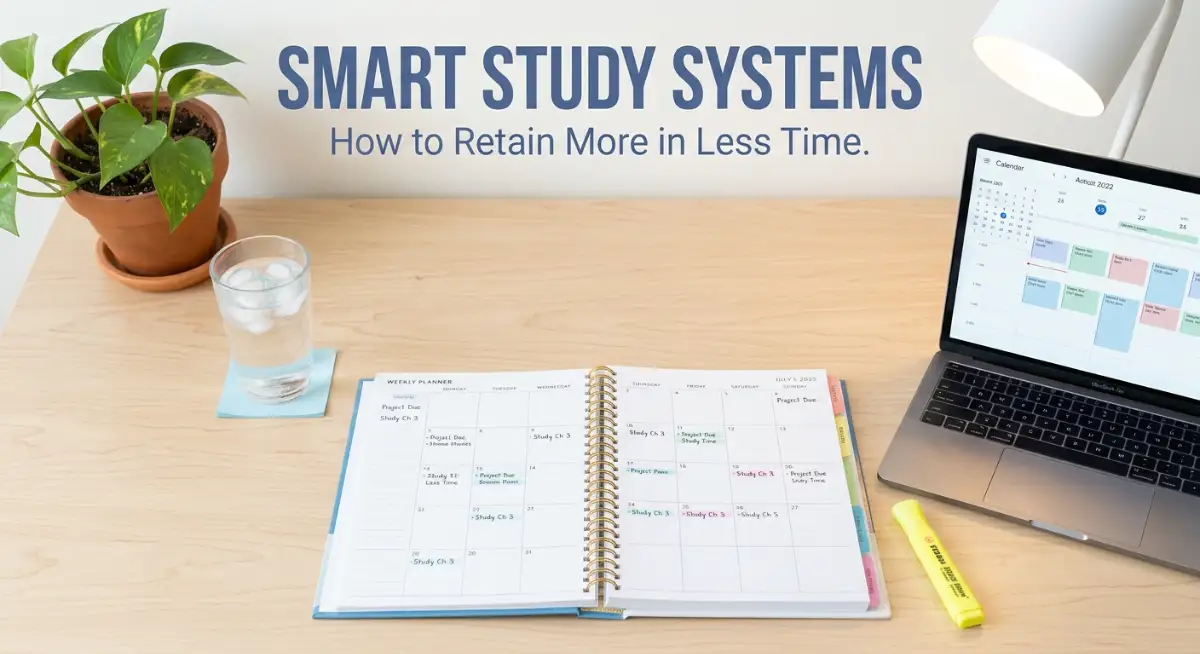
Some students spend days color-coding their calendars, buying expensive planners, and organizing their desks perfectly. They get a temporary rush of satisfaction from planning to study without actually doing any real work.
This is a form of productive procrastination that makes you feel like you are moving forward when you are actually standing still. A perfect schedule is completely useless if you never actually open your textbook and start reading.
Keep your planning system as simple as possible so it does not become a distraction in itself. A basic list of topics and a simple timer are all you really need to get started.
Trying to Learn While Your Mind Is Exhausted
Your brain requires physical energy to build new neural connections and store information securely. When you cut back on sleep to study, you are severely damaging your brain's ability to retain what you read.
According to academic success guides, sleep deprivation ruins your focus and makes it much harder to recall simple facts. You might spend eight hours studying while tired, but your brain might only remember a fraction of that work.
Make sure you prioritize at least seven to eight hours of quality sleep every night, especially before major exams. Physical movement, proper hydration, and healthy meals are just as important for your grades as the books you read.
Getting your mind into the right analytical state takes patience and practice. It is very similar to the focus required when you are analyzing difficult texts like financial contracts or other dense documents.
Your Path to Smarter Learning and Better Results
Improving your grades does not mean you have to sacrifice your social life or sleep through your weekends. By replacing passive study habits with active learning methods, you can achieve better results in half the time.
Start by making small, gradual changes to your daily routine instead of trying to overhaul everything at once. Pick one specific strategy, like active recall, and practice it consistently for a week.
As you begin to see progress, your confidence will grow, and studying will start to feel much less stressful. You will reclaim your free time and finally enjoy the learning journey without the constant dark cloud of academic anxiety.
I spent years feeling frustrated by my own poor results until I finally changed the way I approached my books. Once I stopped highlighting passively and started testing myself actively, my learning became easier and my grades naturally improved. I want you to know that you are fully capable of mastering any subject once you start working with your brain instead of against it.
Frequently Asked Questions on Fixing Your Study Routines
How do I know if my current study habits are actually working?
The best way to test your study habits is to perform a quick self-assessment without looking at your notes. If you cannot explain the core concepts of a topic in simple terms to a friend, your current study habits are likely too passive. You should also look at your exam trends to see if your preparation matches your actual results.
Is it bad to study with music playing in the background?
It depends on the type of music you choose and how your brain handles background noise. Instrumental music or simple ambient sounds can help block out distracting household noises without pulling your focus away from your work. However, music with lyrics often competes for your brain's language processing centers, making it much harder to comprehend complex reading materials.
How long should a single study session last for maximum focus?
Most scientific research suggests keeping your highly focused study blocks between twenty-five and fifty minutes long. After this period, your brain's ability to maintain deep attention naturally begins to decline. Always take a short five to ten-minute break to walk around and rest your eyes before starting your next study block.
Can I use these active study methods for highly technical subjects like medicine or law?
These active learning strategies are highly effective for dense, technical subjects that require deep comprehension. In fact, medical and law students frequently use active recall and spaced repetition to manage the massive volume of information they must memorize. If you are learning to navigate complex topics, it is very similar to the careful process used for understanding complex research papers and dense documents.
How do I stop myself from procrastinating when a subject feels too dry?
Try using the five-minute rule, which involves committing to study the dry material for just five minutes with the option to stop if it feels too painful. Most of the friction we feel exists in the simple act of starting, and once you get past that initial barrier, it is much easier to keep going. You can also break the boring topic down into tiny, bite-sized tasks so your brain does not feel overwhelmed by the entire project.
![7 Proven Strategies to Survive Your First College Semester [Without Burning Out]](https://techinfomart.com/storage/uploads/blogs/1788053391_7-proven-strategies-to-survive-your-first-college-semester-without-burning-out.webp)