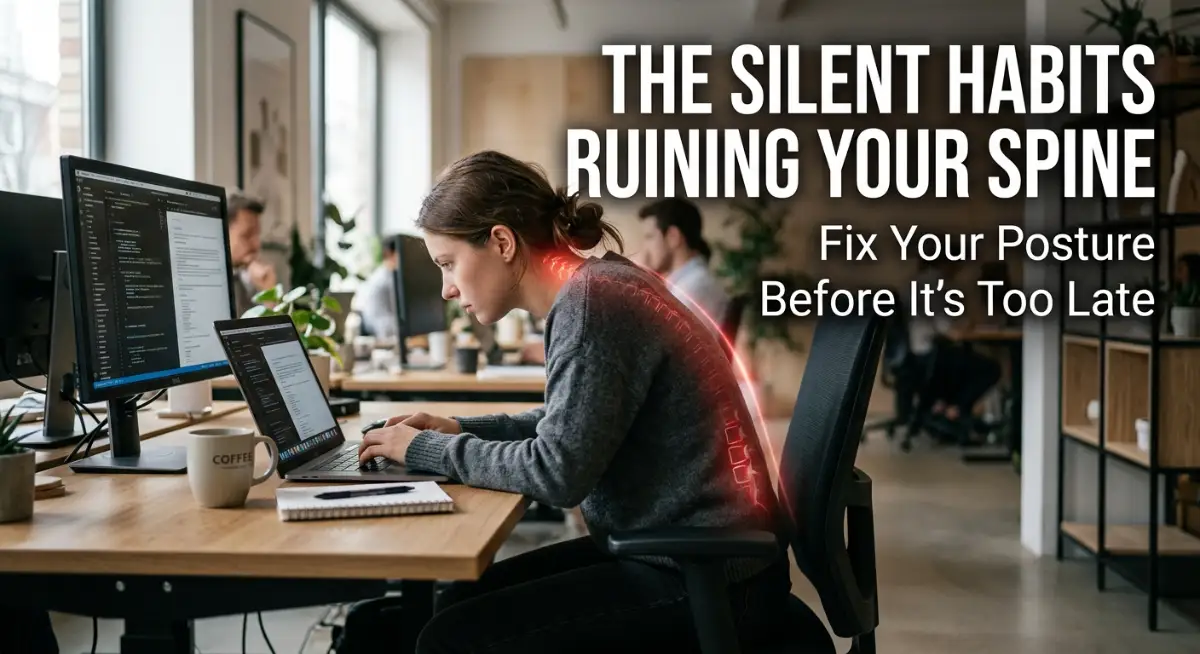
The Unexpected Moment I Realized My Back Was Screaming for Help
I clearly remember the exact moment my body finally said enough was enough. I was simply bending down to pick up a dropped pen from my living room floor. Suddenly, a sharp, burning sensation shot right up my lower spine, leaving me completely frozen in place.
At first, I honestly thought I just slept in a weird position the night before. I brushed it off, took a hot shower, and went back to my desk to start my workday. But as the weeks went by, that dull, heavy ache in my lower back became my constant companion.
I was constantly shifting in my chair, trying to find a comfortable angle that simply did not exist. My neck felt like it was carrying a massive boulder, and I started getting these random, annoying tension headaches every single afternoon. I felt so drained, grumpy, and unusually tired, even after drinking multiple cups of coffee.
It took me a long time to figure out that my sudden pain had absolutely nothing to do with getting older or having a weak back. The real enemy was hiding in plain sight. My everyday routine was secretly destroying my spine, one tiny movement at a time.
For millions of people, this is a very familiar and frustrating daily reality. You wake up feeling stiff, and by the time you finish your workday, your shoulders are tight up by your ears. We often blame stress, our mattresses, or just bad luck for this intense physical discomfort.
But the truth is far more simple and a lot more surprising. We are casually repeating tiny, unnoticed movements every single day that put immense pressure on our joints. This constant physical stress drains your mental energy and makes it incredibly hard to focus on your work or enjoy time with your family.
You start skipping your evening walks because your lower back feels too heavy. You stop playing with your kids on the floor because getting back up feels like a massive chore. The emotional weight of dealing with chronic, unexplained body aches is just as heavy as the physical pain itself.

Everyday Traps That Secretly Damage Your Spinal Alignment
It is totally normal to think that heavy lifting or a sudden sports injury is the main cause of back problems. However, science tells us a completely different story about human anatomy. It is actually the low-grade, repetitive stress from our daily routines that wears down our spinal discs over time.
Think of your spine like the main structural pillar of a tall building. If that pillar is perfectly straight, the building can easily support an massive amount of weight without any issues. But if you slightly tilt that pillar to one side, the entire structure becomes incredibly unstable and fragile.
Our bodies operate on the exact same mechanical logic. When we force our spine out of its natural, healthy curve for hours at a time, our muscles have to work overtime just to keep us upright. Let us explore the most common sneaky habits that are forcing your muscles to work much harder than they should.
The "Text Neck" Epidemic Taking Over Our Lives
Take a second to notice exactly how you are reading this article right now. Are your shoulders slightly rounded forward? Is your chin dropped heavily toward your chest?
If you are looking down at a smartphone or a laptop, there is a very high chance you are holding your head in a highly unnatural position. The human head weighs roughly 10 to 12 pounds when resting in a neutral, upright position.
But according to basic physics, the further you tilt your head forward, the heavier it becomes for your neck muscles to support. When you bend your neck at a 60-degree angle to scroll through social media, your head effectively puts up to 60 pounds of pressure on your cervical spine.
Imagine walking around all day with a heavy bowling ball strapped directly to your forehead. That is the exact amount of mechanical stress you are putting on your delicate neck joints. Over time, this constant forward pull overstretches the ligaments in the back of your neck and dangerously tightens the muscles in your chest.
Immediate Action Steps for Healthier Screen Time
You do not have to throw your smartphone away to fix this annoying issue. The solution is entirely about changing the angle of your environment, not your device.
Always try to bring your phone directly up to eye level instead of dropping your chin down to look at your hands. If you are sitting on the couch, prop a large pillow under your arms to support the weight of your elbows.
When working on a laptop, consider placing it on a stack of thick books so the top third of the screen is exactly aligned with your natural eye line. These tiny environmental tweaks instantly remove the heavy mechanical load off your upper spine.
The Illusion of the "Comfortable" Office Chair
We spend a massive chunk of our lives sitting down, especially if we work remotely or have a standard desk job. Most people naturally assume that sitting is a resting position that gives our bodies a break.
In reality, sitting actually places significantly more physical pressure on your lower spinal discs than standing does. When you slouch backward in your chair, your pelvis naturally tilts away from its neutral position.
This rounding of the lower back flattens out the natural lumbar curve that acts as your body's built-in shock absorber. As you lose that protective curve, all the weight of your upper body crashes directly down onto your lower spinal segments.
This causes the surrounding muscles to aggressively tighten up in an attempt to protect your delicate nerves. That tightening is exactly what causes that familiar, burning ache right above your hips after a long day of typing.
Are you constantly struggling with this exact mid-afternoon back ache? Check out this incredibly helpful video demonstration showing exactly how to reset your seating posture in under two minutes.
Watch This Quick Office Chair Posture Reset Routine:
The Danger of One-Sided Carrying
This is a habit that sneaks up on almost everyone, from busy college students to daily office commuters. We all have a dominant side of our body, and we naturally favor it without even thinking.
You probably carry your heavy tote bag, backpack, or briefcase on the exact same shoulder every single morning. You might even hold your growing toddler exclusively on your left hip while cooking dinner with your right hand.
When you constantly load a heavy weight onto one side of your body, your spine has to curve sideways to prevent you from falling over. Your shoulder naturally hikes up toward your ear to stop the bag strap from sliding down your arm.
This creates a massive muscle imbalance over months and years of repetition. The muscles on your carrying side become incredibly tight and overworked, while the muscles on the opposite side become weak and stretched out.
I used to carry a heavy leather laptop bag on my right shoulder every single day for years. I finally realized this was the exact reason my right shoulder was always sitting two inches higher than my left one in photographs. Once I switched to a supportive, two-strap backpack, that constant nagging tension completely disappeared within a month.
The Truth About Your Sleeping Position
You spend roughly a third of your entire life asleep in your bed. That means your sleep posture is heavily dictating how your spine feels during your waking hours.
Many people love sleeping flat on their stomachs because it feels warm, secure, and incredibly cozy at the end of a long day. However, stomach sleeping is widely considered the absolute worst possible position for your spinal health.
When you sleep on your stomach, you are forced to aggressively twist your neck to one side just to breathe properly. Imagine walking around all day with your head twisted sharply to the right.
Your neck would be completely locked up in agonizing pain within an hour. Yet, stomach sleepers subject their bodies to this exact twisting motion for seven or eight straight hours every single night.
On top of the severe neck strain, stomach sleeping completely flattens out the natural arch of your lower back. Your midsection sinks deeply into the mattress, putting heavy strain on your lower lumbar discs.
Smarter Sleeping Alternatives
If you want to wake up feeling refreshed and pain-free, side sleeping and back sleeping are much safer alternatives for your joints. But simply changing positions is not always enough to fully protect your alignment.
If you are a dedicated side sleeper, you must place a firm pillow directly between your knees. This single adjustment prevents your top leg from dragging your pelvis forward and twisting your lower spine.
If you prefer sleeping on your back, place a rolled-up towel or a soft pillow directly underneath your knees. This slightly elevates your legs and beautifully preserves the natural, healthy curve of your lower back while you dream.
Debunking the Myth of Posture Correctors
When people first start feeling the physical effects of bad posture, they often panic and rush to buy quick fixes. You have probably seen endless online advertisements for tight, elastic posture braces that promise to pull your shoulders back instantly.
Myth vs. Reality: Do Posture Braces Actually Work?
- The Big Myth: Wearing a tight shoulder brace all day will permanently fix your slouching habit and cure your back pain without any effort.
- The Scientific Reality: These devices can actually make your long-term posture significantly worse if you rely on them too much.
When a tight strap physically holds your shoulders back, your brain tells your natural postural muscles to stop working. Your back muscles become incredibly lazy because the elastic brace is doing all the heavy lifting for them.
The moment you finally take the brace off, your weakened muscles can no longer support your spine properly. You will instantly collapse right back into a severe slouch, often feeling much worse than when you started.
Instead of relying on an external strap, you need to gently train your own muscles to do their job. Building natural muscle memory is the only proven, sustainable way to permanently improve how you carry yourself.
The Hidden Impact of Your Footwear Choices
We rarely connect the shoes on our feet to the intense pain in our upper neck, but the human body is entirely interconnected. Your feet are the literal foundation of your body's entire physical structure.
If your foundation is wobbly, unsupportive, or uneven, the upper floors of the building will inevitably suffer the consequences. Wearing completely flat, unsupportive shoes like flip-flops or thin ballet flats forces your body to absorb massive shock waves with every step.
When you lack proper arch support, your feet naturally roll inward as they hit the solid pavement. This inward rolling motion forces your knees to cave in, which heavily tilts your pelvis forward.
That aggressive pelvic tilt pulls your lower spine out of alignment, creating a domino effect that travels all the way up to your skull. This is why a simple walk around the neighborhood in bad shoes can leave you with a pounding tension headache.
The Power of Frequent Micro-Movements
The human body was designed by nature to move constantly, stretch deeply, and adapt to different environments. The biggest enemy of healthy posture is not necessarily sitting or standing; it is staying completely frozen in one single position for way too long.
Even if you have the most expensive, highly rated ergonomic office chair on the market, sitting perfectly still for five hours will still damage your tissues. Your muscles need regular, rich blood flow to deliver oxygen and sweep away painful inflammatory waste products.
You do not need an intense, sweaty gym workout to keep your spine happy and hydrated. You simply need to introduce frequent, effortless micro-movements into your daily routine.
Try to stand up, reach both arms high above your head, and take a deep breath every single time you finish reading an email. Gently roll your shoulders backward in a slow, circular motion while you are waiting for your morning coffee to brew.
These tiny, almost unnoticeable moments of movement prevent your connective tissues from freezing up and becoming glued together. Your body desperately craves variety, and feeding it small doses of movement throughout the day is the ultimate secret to long-term spinal health.
Beyond Basic Stretching: Advanced Strategies to Reprogram Your Body
If you want to permanently change how your body carries itself, you have to move past simple stretching routines. Most people try to fix a slouch by simply forcing their shoulders backward as hard as they can.
This aggressive approach almost never works in the long run. Your brain will eventually get distracted by an email or a phone call, and you will instantly melt right back into your old slouched position.
To create lasting physical changes, you have to retrain your nervous system and strengthen your deep stabilizing muscles. Think of it like understanding a home loan; you cannot just look at the monthly payment, you have to understand the entire underlying structure. Your body works on the exact same principle of underlying mechanics.
Mastering the Art of "Inner Corset" Activation
We hear the word "core" all the time in fitness magazines, and most people immediately picture someone doing hundreds of painful sit-ups. But your true core has absolutely nothing to do with visible stomach muscles.
Your spine is protected by a deep, hidden layer of muscle called the transverse abdominis. It acts exactly like a tight, protective corset wrapping completely around your midsection. According to the National Institutes of Health guidelines on spinal mechanics, activating this deep muscle group is the primary key to taking pressure off your lower back.
You can actually practice activating this muscle right now, while you are sitting down. Imagine someone is about to poke you in the stomach, and you instinctively tighten your belly to protect yourself.
That subtle, internal tightening is your inner corset turning on to support your spine. If you can hold that gentle tension for just ten seconds while breathing normally, you are already building powerful muscle memory.
The Hidden Connection Between Your Breath and Your Bones
This might sound a little strange at first, but how you breathe heavily dictates how your spine rests. When we are stressed at work or completely absorbed in a screen, we tend to take very shallow, rapid breaths directly into our upper chest.
This shallow chest breathing forces your neck and shoulder muscles to work incredibly hard just to lift your ribcage. Over time, these secondary breathing muscles become exhausted, leading to that heavy, burning sensation at the base of your skull.
The experts at the Cleveland Clinic recommend diaphragmatic breathing to instantly reduce this upper body tension. To do this properly, place one hand gently over your belly button and take a slow breath in through your nose.
You should feel your stomach physically push outward into your hand, while your chest stays relatively still. This deep belly breathing naturally forces your shoulders to drop down and physically lengthens your entire spine.
Upgrading Your Environmental Ergonomics
Your physical environment will always win a battle against your willpower. If your laptop is sitting flat on a low coffee table, your brain will inevitably force your neck to bend downward, no matter how hard you try to resist.
You have to design a daily workspace that practically forces you to sit correctly without thinking about it. Start by checking the height of your primary office chair.
When you sit down, your hips should actually rest slightly higher than your knees. This slight downward slope opens up your pelvis and effortlessly restores the natural, healthy curve in your lower back.
It is also incredibly smart to learn about reading medical insurance documents before you actually need physical therapy. When we ignore these environmental red flags, the resulting medical bills for chronic pain treatments can be absolutely overwhelming.
The 20-20-20 Rule for Cervical Spine Health
Eye strain and neck pain are deeply interconnected issues that feed off each other. When your eyes get tired from staring at a bright screen, you unconsciously lean your head closer to the monitor to see better.
This creeping forward motion is the exact reason you end your workday with a stiff, heavy neck. To break this cycle, you need to implement a simple visual reset rule into your daily routine.
Every 20 minutes, look completely away from your digital screen. Find an object that is roughly 20 feet away from you, and stare at it for a full 20 seconds.
This brief pause relaxes the tiny muscles inside your eyes and naturally pulls your head back over your shoulders where it belongs. It is like writing clear instructions for your nervous system, reminding it to reset your physical baseline.

The Dangerous Pitfalls People Fall Into When Trying to Fix Their Back
When you are living with constant, nagging discomfort, you will naturally look for the fastest possible way out. This desperation often leads people to make impulsive decisions that actually cause significantly more damage to their joints.
I have watched so many well-meaning friends try to aggressively force their bodies into submission. They treat their spine like a stubborn machine that needs to be hit with a hammer, rather than a delicate structure that needs gentle guidance.
Falling for quick fixes is just like falling for insurance policy pitfalls; they look great on the surface but leave you completely unprotected when things go wrong. Let us explore the most common and dangerous mistakes you must avoid at all costs.
The Illusion of "Stretching Away" the Pain
When the back of your neck feels incredibly tight, your first instinct is usually to grab your head and stretch it forward as hard as you can. It feels somewhat good in the moment, but it is actually the worst thing you can do for a slouched body.
Here is a fascinating mechanical fact: the muscles in the back of your neck are not tight because they are short; they are tight because they are overstretched. They are constantly holding on for dear life, trying to prevent your heavy head from falling onto your keyboard.
When you aggressively stretch these already overworked muscles, you are creating tiny micro-tears in the tissue. The American Physical Therapy Association warns against aggressive neck stretching because it triggers an inflammatory response that ultimately makes the area much stiffer the next morning.
Instead of stretching the back of your neck, you actually need to stretch the front of your chest. When you open up your tight chest muscles, your shoulders naturally glide backward, which instantly relieves the intense pulling sensation on your neck.
Jumping into Heavy Weightlifting Too Fast
Another massive mistake people make is thinking they need to hit the gym and lift heavy weights to build a "strong back." They jump straight into complex exercises like heavy deadlifts or barbell rows without fixing their underlying alignment first.
If you attempt to lift a heavy weight while your spine is stuck in a rounded, slouched position, you are asking for a major disaster. Your compressed spinal discs cannot safely handle that heavy external load.
This often leads to severe pinched nerves or bulging discs, turning a mild annoyance into a major medical emergency. This is one of those fatal financial mistakes you make with your body—paying a huge, painful price for rushing the process. You must learn how to stabilize your own body weight before you ever pick up a dumbbell.
Relying on Painkillers to Survive the Workday
We live in a culture that heavily normalizes popping an over-the-counter pain pill the second we feel a slight ache. While this is totally fine for an occasional headache, using medication to survive your daily desk job is a massive red flag.
Pain is simply your brain's alarm system, warning you that something in your environment is physically harming your tissues. If you constantly mute that alarm system with medication, you will continue doing the exact movements that are destroying your joints.
You might not feel the damage happening today, but your cartilage is still wearing down at an alarming rate. It is like ignoring the hidden traps in a legal contract; burying your head in the sand will only make the eventual outcome much worse.
The "Perfect Sitting" Obsession
Some people swing entirely in the opposite direction and become completely obsessed with sitting perfectly straight. They puff their chest out, lock their knees together, and hold their spine completely rigid for hours.
This military-style rigidity is just as bad as slouching heavily over your keyboard. Holding your body completely stiff cuts off blood circulation and exhausts your postural muscles incredibly fast.
Healthy alignment is supposed to feel relaxed, fluid, and entirely dynamic. If you feel like you are physically fighting your body just to sit up straight, you are pushing way too hard.
Your Personal Action Plan for Tomorrow Morning
Fixing years of poor physical habits is not going to happen overnight, and that is perfectly okay. You do not need to buy expensive gadgets or completely redesign your entire life to start feeling better.
The secret to success is focusing on tiny, manageable changes that easily fit into your current routine. Start by simply becoming highly aware of where your head is resting while you scroll through your phone on the couch.
Notice how your lower back feels when you are driving your car or sitting at the dinner table. This simple, gentle awareness is the first major step toward breaking the automatic cycle of poor alignment.
Choose just one small adjustment to focus on tomorrow, like placing a pillow behind your lower back at work or keeping your feet flat on the floor. Once that small habit feels completely natural, you can easily stack another healthy habit on top of it.
I completely understand how frustrating it feels to be trapped inside a stiff, aching body. I used to think my heavy shoulders and daily headaches were just a normal part of getting older. But once I started treating my body with patience and giving it the proper support it needed, everything completely changed for me. You absolutely have the power to take control of your physical comfort, and it all starts with your very next movement.
Common Questions About Managing Spinal Tension
Can years of really bad slouching actually be reversed?
Yes, it is entirely possible to reverse the effects of long-term slouching through consistent effort. Your muscles and connective tissues are highly adaptable and will respond beautifully to regular, gentle retraining.
Does simply walking outside help improve my back pain?
Absolutely! Brisk walking is one of the most effective ways to naturally rotate your spine and lubricate your lower back joints. It forces your pelvis to move dynamically, which releases trapped tension in your lower back.
Why does my upper back burn so much when I try to sit up straight?
That burning sensation means your weakened postural muscles are suddenly working much harder than they are used to. It is exactly like the muscle soreness you feel after a new gym workout, and it will fade as you get stronger.
Is it actually healthier to sleep completely flat without a pillow?
Sleeping without a pillow is usually only beneficial if you are a strict stomach sleeper. If you sleep on your back or side, you absolutely need a supportive pillow to fill the empty gap between your neck and the mattress.
Do standing desks permanently cure all lower back problems?
A standing desk is a great tool, but standing perfectly still all day will still cause your lower back to ache. The absolute best approach is frequently alternating between sitting, standing, and walking around the room.