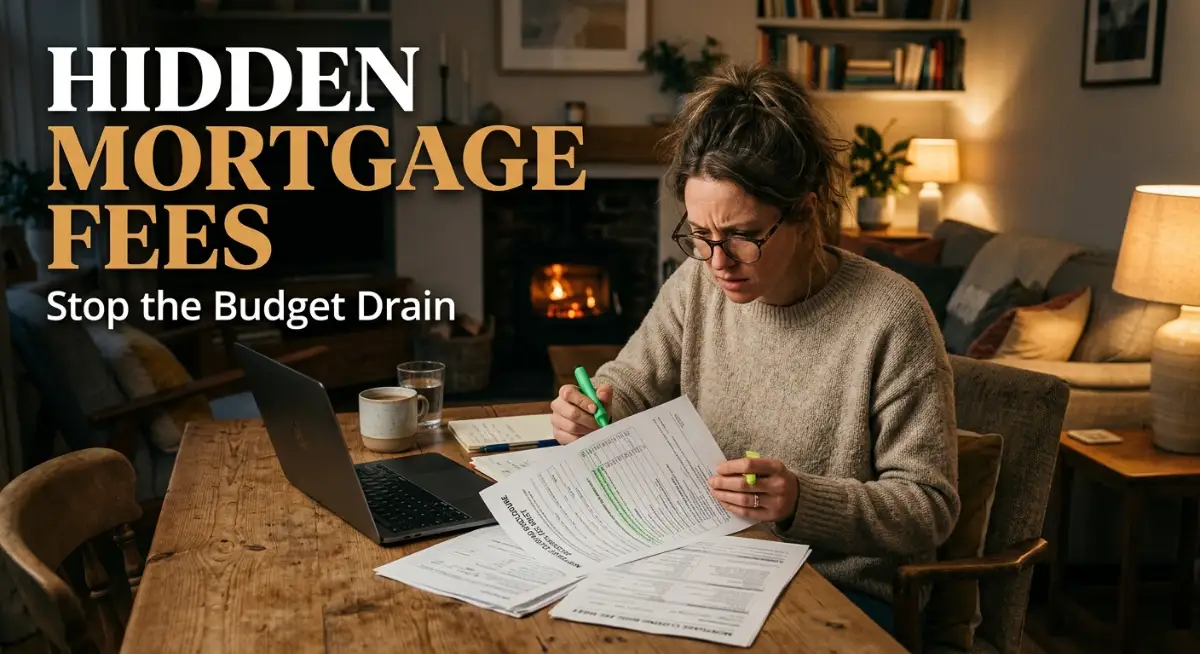
The Shocking Phone Call That Almost Ruined My Dream Home
I was sitting on my living room floor, completely surrounded by half-packed cardboard boxes and rolls of bubble wrap. I had just checked my savings account for the tenth time that week, feeling incredibly proud of the down payment I had managed to scrape together. I thought I had everything perfectly planned out down to the very last penny. Then, my phone rang, and it was my loan officer calling with the final numbers for my closing disclosure. He casually mentioned that I needed to wire an extra seven thousand dollars to the title company by Friday, or I would lose the house.
I instantly felt a cold sweat break out across my forehead. My stomach dropped completely. I had no idea where I was going to find that much extra cash in just three days.
This is the exact nightmare that catches thousands of hard-working homebuyers completely off guard every single month. You spend years sacrificing vacations and skipping meals out just to save up for a decent down payment. You finally find a house you love, you get your offer accepted, and you think the hardest part is over. But suddenly, an invisible avalanche of hidden charges drops right on your head.
These extra expenses completely destroy your peace of mind and turn what should be a happy milestone into a period of extreme anxiety. People literally lose sleep wondering if they will have to drain their emergency funds or borrow money from relatives just to close the deal. The financial buffer you thought you had for buying new furniture or fixing a leaky roof vanishes instantly.
The worst part is how lenders casually brush these costs off as "standard closing fees." They use complicated banking language to make you feel like you just have to accept whatever number they print on the paper. But you do not have to be a helpless victim in this process. You can actually fight back, protect your hard-earned savings, and take total control of your home buying budget.
Tearing Down the Wall of Invisible Home Buying Costs
To stop these sneaky fees from draining your wallet, we first need to drag them out of the shadows. Lenders love to bury these expenses deep within a document called the Loan Estimate. They group them into confusing categories that sound highly official and mandatory.
However, when you break these charges down logically, you will quickly realize that some of them are entirely negotiable. Others are simply administrative junk fees that lenders add just to boost their own profit margins. Let us walk through the most common financial traps hiding in your mortgage paperwork and learn how to disarm them before they explode your budget.

Decoding the Origination Charge Trap
When you look at your loan paperwork, the very first massive fee you will likely spot is the "Origination Fee." Lenders frame this as the basic cost of doing business with them. They claim it covers the administrative work of processing your application, evaluating your credit, and preparing the massive stack of legal documents.
Typically, this fee ranges from half a percent to one full percent of your total loan amount. If you are borrowing three hundred thousand dollars, you could be hit with a three thousand dollar bill just for the privilege of borrowing money. What lenders will not openly tell you is that this number is totally made up.
There is no federal law dictating how much a bank must charge for origination. It is simply a profit center for the bank. You have every right to challenge this specific line item.
When you get your initial estimate, ask the lender to clearly explain every single sub-charge bundled inside this fee. Sometimes they sneak in "application fees" or "underwriting fees" that you can actually ask them to waive entirely. If one bank refuses to lower their origination cost, you can simply take their offer to a competitor and ask for a better deal.
Want to know exactly how to read a Loan Estimate without getting confused? Watch this brilliant visual breakdown from a top real estate educator right here:
The Escrow Account Padding Trick
Another massive drain on your cash is the setup of your initial escrow account. Think of an escrow account as a forced, locked savings jar controlled entirely by your lender. They use this jar to pay your yearly property taxes and your homeowners insurance premiums on your behalf.
To make sure this jar never goes empty, lenders force you to fill it up heavily on the day you close on the house. They call these "prepaid expenses." You are basically paying for future bills months before they are actually due.
For example, your lender might force you to deposit six full months of property taxes upfront. If property taxes in your area are high, this single requirement can add several thousands of dollars to your closing bill. It feels incredibly unfair because this is technically your money, but you are not allowed to touch it.
While you cannot usually avoid escrow completely, you can question the lender's math. Sometimes their estimated tax calculations are entirely wrong, based on outdated county records. Always double-check their numbers against the actual property tax history of the home to ensure they are not forcing you to overfund that account.
The Appraisal and Inspection Avalanche
When you buy a house, you are not just paying for the property itself. You are paying a small army of third-party professionals to tell the bank that the house is a safe investment. The most common of these is the home appraisal fee.
An appraiser visits the property to confirm its true market value. Lenders mandate this because they will not loan you more money than the house is actually worth. This fee usually costs anywhere from four hundred to eight hundred dollars, and it comes straight out of your pocket.
However, things get really expensive when the initial appraisal gets delayed or requires a follow-up visit. Sometimes the appraiser demands a "re-inspection" to verify that a minor repair was completed. That second visit will trigger another unexpected fee that gets quietly tacked onto your final bill.
Then you have your own personal home inspections. You might pay for a general inspector, a pest inspector, and a structural engineer. While these are necessary to protect yourself from buying a damaged house, these costs add up aggressively and are almost never included in your lender's initial estimate.
The Confusion of Title Search and Insurance
Title fees are often the most confusing part of the entire home buying process. Before you can legally own a house, a title company must conduct a deep historical search. They dig through old public records to ensure no long-lost relatives or unpaid contractors have a secret legal claim to the property.
After they do this search, they force you to buy "Lender’s Title Insurance." This policy protects the bank if someone suddenly sues for ownership of the house five years from now. Let me repeat that clearly: you are paying for an insurance policy that only protects the bank, not you.
If you want to protect your own financial interest in the property, you have to buy a second, completely separate policy called "Owner’s Title Insurance." Buying both policies can easily cost over a thousand dollars.
Here is where I messed up badly during my own home buying journey.
I was so overwhelmed by the paperwork that I just let my real estate agent pick the title company for me, assuming all prices were the same. I later found out I was charged almost double the average local rate just because I did not bother to shop around. My biggest piece of advice: You have the legal right to choose your own title company, so always get three different quotes before agreeing to anything.
The Deceptive Allure of Discount Points
When you are reviewing your loan options, your lender might offer you the chance to "buy down" your interest rate. They do this by selling you something called mortgage discount points. This is a very common tactic that often confuses first-time buyers.
One discount point typically costs exactly one percent of your total loan amount. In exchange for paying this large lump sum upfront, the lender will lower your ongoing interest rate by a fraction of a percent. They market this as a massive money-saving opportunity for your future.
On paper, paying for a lower interest rate sounds like a highly logical move. It makes your monthly payment smaller and more manageable. However, you have to calculate the "break-even point" before you agree to this hidden expense.
If spending three thousand dollars on points saves you fifty dollars a month, it will take you sixty months just to recover your initial upfront investment. If you plan to sell the house or refinance the loan before those five years are up, buying those points was a total waste of your hard-earned cash.
Sneaky Rate Lock Extension Penalties
Interest rates in the housing market change constantly throughout the day. When you finally secure a rate that you like, your lender will offer a "rate lock." This guarantees your specific interest rate will not go up for a set period, usually thirty to forty-five days.
This sounds like a great protective measure, and it usually is. But what happens if your closing gets delayed? What if the seller needs an extra week to move out, or the title company finds a missing document?
If your rate lock expires before the official closing day, the lender will hit you with a "rate lock extension fee." This fee is totally unpredictable. Sometimes it is a flat charge of a few hundred dollars, but other times it is calculated as a daily percentage of your loan amount.
A simple one-week delay can quietly add a massive penalty to your final closing statement. To protect yourself, always ask your lender about their specific extension policy upfront. If the delay is clearly the lender's fault, you must firmly demand that they waive the extension fee completely.
Homeowners Association (HOA) Transfer Traps
If you are buying a property in a neighborhood with a Homeowners Association, prepare yourself for another layer of invisible fees. The lender does not control these costs, which is exactly why they often catch buyers completely off guard at the closing table.
When a property changes hands, the HOA charges a "transfer fee" simply for updating their internal neighborhood records. It is a pure administrative cash grab. Depending on the neighborhood, this simple data entry task can cost you anywhere from two hundred to over a thousand dollars.
Some aggressive associations also demand an "upfront capitalization fee." This means they force you to pay several months of HOA dues in advance to build up the neighborhood's reserve fund.
Your lender will usually estimate these costs on your initial paperwork, but their guess is often highly inaccurate. You need to directly contact the HOA management company yourself during the inspection period. Ask them for a written breakdown of every single fee they will charge a new buyer on closing day.
The Death by a Thousand Paper Cuts
Beyond the massive fees we just discussed, your budget will also suffer from a dozen tiny, seemingly harmless charges. Lenders will charge you a fee just to pull your credit report. They will charge you a fee for the courier who physically delivers the loan documents.
You will see strange line items like "flood certification fees" or "tax monitoring services." Each of these individual charges might only be twenty or fifty dollars. By themselves, they look entirely harmless.
But when you add up fifteen different random administrative charges, you are suddenly looking at another thousand dollars vanishing from your bank account. These are the classic junk fees that banks use to pad their bottom line.
You must read every single line of your Loan Estimate. If you do not know what a specific fee means, point to it and ask the lender to justify its existence. Do not let the bank intimidate you into staying quiet.
By actively questioning these charges, you signal to the lender that you are an educated consumer. They are much less likely to try and sneak extra padding into the final documents if they know you are actually paying attention to the math.
Defending Your Wallet Like a Real Estate Insider
Finding hidden charges early is only half the battle when securing your property. The real test comes when you actually have to confront your lender about these extra costs. Most buyers simply accept the first set of numbers they see because they feel completely intimidated by bank officials.
You must remember that you are the customer, and the lender is actively competing for your business. A mortgage is a massive financial product, and just like buying a car, the initial price tag is almost always flexible. Let us explore some powerful strategies to strip away the unnecessary padding from your loan documents.
You can build a strong defense against these sneaky charges by learning how to properly leverage your initial paperwork.
Mastering the Official Loan Estimate Breakdown
The single greatest weapon you have against sneaky charges is a document called the Loan Estimate. By law, every lender must hand you this standardized form within three business days of receiving your application. It outlines your estimated interest rate, monthly payment, and every single closing cost associated with the transaction.
You need to pay very close attention to page two of this document. It is split into very specific categories that dictate exactly what you can and cannot negotiate. For a deeper dive into organizing these initial documents, reading a guide on understanding your home loan step by step will give you incredible confidence.
Section A contains the origination charges set directly by the lender. These are the application fees, processing fees, and underwriting fees that go straight into the bank's profit margins. This is where you focus all your negotiation energy because the lender has total control over these numbers.
The Power of Comparing Loan Estimates Side-by-Side
If you only apply with one bank, you have absolutely zero leverage to ask for a discount. The loan officer knows you have no backup plan, so they will easily refuse to lower their processing fees.
You must gather at least three different Loan Estimates from three entirely different institutions. Get one from a local credit union, one from a major national bank, and one from an independent mortgage broker. Lay all three documents side-by-side on your kitchen table and compare Section A line by line.
When you find the lowest origination fee, call the other two lenders immediately. Tell them directly that you want to work with them, but another bank is offering a much lower processing fee. You would be amazed at how fast a stubborn loan officer will suddenly drop a thousand-dollar fee just to keep your business.
Understanding the APR Illusion
Lenders often try to distract you from high upfront costs by flashing a really low interest rate in your face. They want you to focus entirely on the monthly payment instead of the cash you have to bring to closing.
To see through this trick, you must always look closely at the Annual Percentage Rate (APR). The APR is a special number that combines your base interest rate with all the upfront fees the lender is charging you. It shows you the true, mathematical cost of borrowing the money over a full year.
If a lender offers you a super low interest rate, but their APR is significantly higher, it means they are hiding massive fees in your closing documents. The federal government actually designed the APR system specifically to help buyers spot these traps. You can read more about how this math works through the official Loan Estimate guidelines provided by the Consumer Financial Protection Bureau.
Negotiating Seller Concessions to Cover Your Costs
If your lender completely refuses to lower their fees, you still have an incredible backup strategy. You can actually ask the person selling the house to pay some of your closing costs for you.
In the real estate world, this is known as asking for "seller concessions" or a "seller credit." If the house has been sitting on the market for a long time, the seller might be desperate to close the deal. Your real estate agent can formally ask them to contribute two or three thousand dollars towards your final bank fees.
This strategy keeps your own hard-earned cash safely inside your bank account. Sellers often agree to this because they still get to sell their house, and the credit simply comes out of their total profit at the end of the day. Exploring resources on techinfomart.com can offer more broad financial tips on keeping your savings intact during big life events.
Asking for an Appraisal Waiver
As we discussed earlier, property appraisals are a very common hidden expense that can cost you hundreds of dollars. But in some very specific situations, you might not actually need one.
If you are putting down a massive down payment, or if the local housing market has extremely strong data, automated systems might instantly verify the property value. When this happens, the bank's software will issue an "appraisal waiver."
However, some lenders will not openly offer this waiver because they have ongoing relationships with local appraisal companies. Always explicitly ask your loan officer if your file qualifies for an automated appraisal waiver. If they say yes, you just instantly saved yourself five hundred dollars and two weeks of waiting time.

The Financial Pitfalls That Catch Buyers Off Guard
Even with a solid strategy, the final weeks of buying a house are highly stressful and chaotic. This is exactly when buyers tend to let their guard down and make terrible financial choices.
When you are busy packing boxes and setting up new utility accounts, it is incredibly easy to just sign whatever papers the bank puts in front of you. Lenders know that buyers are tired and just want the process to be over quickly. They use this exact exhaustion to slip extra charges past you right at the finish line.
If you ignore the fine print during this phase, the financial damage can be massive. Let us look closely at the dangerous traps you must actively avoid to keep your budget safe.
Blindly Accepting Verbal Promises
The single most dangerous thing you can do during a property purchase is trust a verbal promise from a loan officer.
Imagine you complain about a random five-hundred-dollar administrative fee on your initial paperwork. The loan officer smiles and says, "Do not worry about that, we always waive that fee right before closing." You feel relieved and assume the problem is solved.
Three weeks later, you sit down at the closing table, and that exact fee is still sitting on your final bill. The loan officer is nowhere to be found, and the notary tells you that you must pay the fee to get the keys to your house.
If a promise is not written in ink on an official document, it completely does not exist. This is a painful lesson many people learn the hard way, similar to those who fall for the hidden traps in personal loan agreements. Always demand that every single fee reduction is immediately updated and emailed to you on a revised estimate form.
Ignoring the Final Closing Disclosure
Three business days before you officially buy the house, the lender is legally required to send you a document called the Closing Disclosure (CD). This is the absolute final receipt for your home loan.
Many buyers make the massive mistake of ignoring this document until they actually arrive at the title company. They assume it is just a copy of the exact same estimate they received weeks ago. This is a very dangerous assumption.
Fees can change dramatically between the initial estimate and the final disclosure. Sometimes a tax calculation gets updated, or an insurance premium comes in much higher than expected. If you do not catch these changes three days early, you will be completely shocked when you have to write a much larger check.
Skipping the Title Insurance Comparison
As mentioned earlier, you are usually forced to buy a title insurance policy for the lender. However, a shocking number of buyers have no idea that they can actually shop around for this specific service.
Lenders will happily assign you to their preferred title company. Often, this company charges premium rates because they know most buyers will never question the choice.
You have strict consumer rights regarding settlement costs, clearly outlined by the Department of Housing and Urban Development. Do not make the mistake of accepting the default option.
Call three different local title agencies and ask for their basic rate sheet. You can often save hundreds of dollars just by telling your lender that you want to use a different, more affordable title agent. Being proactive here is exactly like learning the tricks insurance companies use to void your policy—you have to protect yourself because no one else will.
Forgetting About Per Diem Interest
Here is a sneaky little charge that completely destroys careful budgets right at the last second. It is called "per diem" or daily interest.
When you close on a house, your first official mortgage payment is usually not due until a full month later. However, you still owe interest to the bank for the exact number of days you owned the home during the closing month.
If you close on the fifth day of the month, you have to pay upfront interest for the remaining twenty-five days of that month. This can easily add an unexpected thousand dollars to your final closing bill.
The smart move is to intentionally schedule your closing date for the very last week of the month. If you close on the twenty-eighth, you only have to pay a few days of daily interest upfront, keeping more cash directly in your pocket.
Real-Life Scenario: The Escrow Buffer Surprise
Let me share a quick story about how escrow calculations can completely blindside you. A friend of mine recently bought a beautiful home in the suburbs. He carefully calculated his property taxes based on what the previous owner paid last year.
What the lender did not tell him was that they require a two-month "buffer" in the escrow account by default. So not only did he have to pay his upcoming taxes, but he also had to deposit two extra months of taxes just to sit there as an emergency cushion.
Because property taxes in his area were high, this buffer requirement added almost two thousand dollars to his closing costs instantly. You should always read up on the legal standards for escrow accounts to understand exactly how much extra cash a bank is allowed to hold hostage in your name.
Your Personal Blueprint for a Safe Closing Day
You now possess the exact knowledge needed to outsmart the confusing banking system and keep your hard-earned money totally safe. Buying a house should be an exciting celebration of your hard work, not a terrifying financial guessing game.
By actively questioning every single line item on your Loan Estimate, you instantly transform from a helpless buyer into a highly educated consumer.
Start treating your loan documents with the exact same caution you would use when figuring out how to read medical insurance documents. Question the junk fees, fight back against excessive origination charges, and never be afraid to walk away if a lender refuses to treat you fairly. You are in total control of this massive financial transaction.
I honestly wish I had known all of these insider secrets before I bought my very first house. My biggest hope is that you take these strategies, apply them bravely today, and keep thousands of extra dollars safely inside your own bank account where they truly belong!
Common Questions About Unexpected Home Buying Costs
What exactly is a mortgage junk fee?
A junk fee is a vague administrative charge added by a lender simply to increase their overall profit. These fees often have confusing names like "document preparation fee" or "funding fee." Because they are not tied to a third-party service like an appraisal, they are highly negotiable.
Can I actually refuse to pay certain closing costs?
You cannot outright refuse to pay mandatory third-party costs like local taxes or official recording fees. However, you can absolutely push back on lender-specific fees like processing charges. If they refuse to lower them, your best option is to take your business to a different lender.
Are seller concessions always allowed on a mortgage?
Most standard loan programs allow sellers to pay a portion of your closing costs, but there are strict limits. Usually, conventional loans cap seller contributions at around three to six percent of the total purchase price. Your loan officer will confirm the exact limit based on your specific down payment size.
Why did my final closing costs change from the initial estimate?
Some costs, like property insurance and daily interest, naturally fluctuate between your application date and your closing date. However, federal law restricts exactly how much lender-controlled fees can increase. You can check FTC warnings on mortgage servicing to ensure your bank is not illegally inflating their fees at the last minute.
Should I drain my savings completely to cover closing fees?
Absolutely not, and most lenders will not even allow you to do this. You should always maintain a healthy emergency fund after closing to cover unexpected repairs or sudden job loss. If your closing fees are draining you completely, ask for a seller credit or look for a slightly cheaper property.
![5 Fatal Mistakes to Avoid During Your Mortgage Pre-Approval [Warning]](https://techinfomart.com/storage/uploads/blogs/1787909587_5-fatal-mistakes-to-avoid-during-your-mortgage-pre-approval-warning.webp)